Friday, December 3, 2010

Escaping...

I have a fabulous idea for a TV show.  If I do say so myself.  The idea struck me as I was contemplating what it is that has me so infatuated with the BBC Show Escape to the Country.

Here in Oz it is being shown on one of the new free-to-air digital stations (7TWO).  Obviously not popular enough to make it to its flagship Channel 7, the network is showing it on one of its offshoots (currently on Friday and Sunday at 8.30pm)

 I came across the show a couple of months ago.  Pitiful though it may sound, I never do anything on a Friday night.  In fact, Friday is the one day of the week that I am likely to be least interested in staying up late or over-imbibing in champagnes or red wines.  I am always mentally exhausted and loll in front of the television for a couple of hours before having an early night.  So for me anyway, the fact that Friday night television is pretty crappy has never been an issue.  The lack of alternatives is, in fact, what allowed me to stumble across the BBC gem.

Not one for lifestyle / makeover type shows I suspect I had flicked past it on a number of occasions before watching enough to get me hooked.

What entices me though, is unclear.  From my extensive research (Google yet again!) I note that the show has (had) a number of presenters and (in the UK) is in its 9th season.  But here in Oz we are seeing episodes from a few years ago fronted by host Catherine Gee.

I suspect part of my fascination with the show is Catherine.  Or more honestly her voice.  As an Aussie, her well-rounded (but not quite plummy) vowels are surprisingly endearing.

And then of course there is the subject matter: homeowners in suburbia wanting to move to the country.  For some peace and quiet; or to grow a vegetable patch; or (as per last night’s episode) raise some alpacas. 

The format of the show is straight forward*.  We meet the country living wannabes and get a look at their current property (what it is worth and how they currently live); then Catherine sits down with them to get their ‘wish list’; both in terms of property inclusions and location.  Most of those featured are still working so need to live close enough to transport to get back to civilization, but still want a balance of rural living with some access to nearby amenities.

Catherine then searches out four properties and looks them over while the wannabes watch via laptop.  They then choose their favourite two to visit.  They then (of course) have the option of pursuing one that they like by putting in an offer etc.  Disappointingly this rarely happens.

For an Aussie, the quintessential English village is enticing.  And romantic.  I was disappointed that last night’s retired couple was after a ‘modern’ home… which translated into some quite unattractive 1970s ‘brick and tile’ house - a common sight in Australian suburbia, but something I wouldn’t touch with a ten foot pole.

I was travelling home from the city this week and as the bus stalled in traffic I read the sign in front of an old Catholic Church.  It decreed that the church was the oldest in my State of Queensland.  It was 160 years old.

On Escape, most of the properties are actually built in the 1800s or even 1700s.  They ooze character, though their upkeep may also ooze digits from one’s bank account.  Here in Oz we have heritage style houses known as Queenslanders.  These timber houses are built for our climate with covered verandahs providing outdoor living space.  The countryside houses in the British show make these houses look positively futuristic. 

So, I am glued to the television screen as Catherine explores the houses with their original fireplaces and stone walls in villages featuring quaint pubs and few shops.  Having always dreamed of living in some tiny English village with an oddly-named pub, I am probably as enthusiastically naive as many of the show’s couples wanting to make the lifestyle change.

But, back to my idea…. For some time popular culture (here and around the world, I suspect) has raised the notion of families, couples and individuals ‘downsizing’.  Here in Oz we talk about a ‘seachange’ or a ‘treechange’ depending on whether it is beachside living or rural Australia that you are craving.  So my idea is for a similar show here, with a Catherine-equivalent scampering about small beachside towns or picturesque hinterlands to locate new lives for harried city-dwellers.  I reckon the show would also sell overseas.  While I live in a 3-level modern apartment gleaming with glass and stainless steel craving the ‘old’, I am sure there are Brits living in rustic England fantasizing about our beaches and clean lines.  So, voila – there it is.  My brainwave.  Perhaps I can sell it to a network and make enough money to go and Escape to the Country myself!

* The aforementioned extensive research also led me to discover that the format changes from series 6.

Saturday, November 20, 2010

Parallel lives

Season 3 of Fringe started on television here in Oz last week and I must admit to gleefully anticipating its return.

Although I missed Season 1 when it first screened, I discovered the show via DVD just before Season 2 commenced and have been a convert ever since.

In fact, I wrote about the show here, contemplating the concept of an alternate universe and the ‘sliding doors’ theory of a twin ‘me’ living a parallel life in a parallel universe out there… somewhere.

I for one, wonder about paths not taken as I get older and (unsurprisingly) suffer regrets – as I am sure most of us do.

But as a new Season dawns and Fringe starts to unravel, I find myself perplexed with the shift in storyline.

As I indicated in my earlier blog, the premise of the show is that there is (in fact) a parallel world; an alternate reality populated by our identical selves going about their business.

Tantalising isn’t it?  I mean, who would we be?  Or more importantly, who COULD we be?  Again, I have to admit that the idea is somewhat comforting as I can only hope that the other me is living a very fulfilling life; taking more risks; following her heart; being happy (etc etc).

So, with so many possibilities I find myself slightly disenfranchised now that we have finally come across the alternate universe in Fringe.  It turns out that our key protagonists are actually doing the same bloody thing they are doing in our world; AND with the same people.  WTF?  So far the only difference between the characters in the alternate world is that their values are slightly screwy.  Oh, and plus a couple of them are dead.

It is a risky move for the writers and producers.  I for one am struggling to ‘care’ about Anna Torv’s fake Olivia who has infiltrated our world while the real one remains stuck in the alternate world.  Although it may be a refreshing change for the actors, it’s a bit like Barbara Eden playing her twin sister in I Dream of Jeannie and Elizabeth Montgomery playing her scheming cousin in Bewitched.  You know they are the same actor, but you just don’t care. I guess that’s the point of the two quite-different personalities.  But I don’t even want to watch the alternate Olivia.  I just want her to die!

Meanwhile (rant over), back to my point…. In contemplating the turn of events in Fringe I am reminded of Sliding Doors, also referenced in my earlier blog.  In the movie, Gwyneth Paltrow’s Helen basically ends up in the same place in both versions of her life.  Only her experiences in getting there vary.  (Oh… and the haircut.)

While this concept of a parallel universe is not new to film, television or literature, it is quite frankly a bit beyond the realm of my expertise.  I could not get my head around the theories postulated in What The Bleep Do We Know, so I figure it’s best left to those into quantum mechanics, neurobiology and human consciousness - and stuff like that.  Instead I am finding myself more intrigued by this concept of fate. I mean, is our destiny pre-determined?  Perhaps the journey in each world varies, but our destinations are the same, no matter what decisions we make or roads we take.

Fate: I can’t work out if I am disappointed (that we have no control over our own destiny) or relieved (that it doesn’t matter if we make wrong choices) at the concept.  But while the notion of an alternate reality remains the stuff of imaginative authors and screenwriters, I must admit to taking some solace in the hypotheses of these works of fiction. As a natural worrier I like the idea of fate and of responsibility being taken out of my hands.  I mean, Phew.

Sunday, October 3, 2010

Thomas and Jessica

I am home sick today.  A terrible headache and aching neck and shoulders kept me in bed for most of the morning.  When I woke at lunchtime I was pretty sure I could happily sleep away the afternoon, but decided I should get up lest I be completely unable to sleep tonight and am rendered inactive tomorrow as well.

After checking and dealing with work emails I settled myself in my comfortable armchair and flicked through television channels looking for something on daytime TV to keep me from my bed.  Staving off head-spins I caught the end of a Judy Garland movie I can't recall ever having seen before (I grew up in regional Queensland on a diet of Sunday afternoon Judy Garland, Mickey Rooney, Fred Astaire and Doris Day movies.) 

Feeling too light-headed to do much else after the movie finished I channel-surfed again before coming across Magnum PI. I can't recall being a huge Thomas Magnum or Tom Selleck fan when the show actually aired back in the 1980s but, as I have always consumed large amounts of television and suffered through a deficiency of options in my home town, I have watched my share of the Hawaiian-based detective. 

Watching it a decade and a half later remains a treat.  Episodes were replayed on a Sunday morning (on and off) last year and I circled it in my TV Guide in an attempt to remember to watch (or tape) it.  Despite the occasionally-wooden acting and (now) very-dated stunts and special effects I was surprised to see a number of familiar faces - including a young Ted Danson, Sharon Stone, Ernest Borgnine and Carol Burnett. 

Today's episode (shown on one of our new free-to-air digital television stations, 7mate) featured a young Miguel Ferrer.  Again I was reminded how much I like and miss shows like this.  I must also confess to be a Murder She Wrote fan.  When the show was replayed on daytime television earlier this year, I set my video to tape it and watch at my leisure. 

I think people either love or hate Angela Lansbury's Jessica Fletcher.  I personally think she morphed into a less-patronising and annoying character over the show's life.  Although I cringed at the sets' and decor (I think I had blocked macrame hanging pot plant holders from my mind), I liked the lack of complexity in the storylines when comparing them to the murder/mysteries on our screens today.

I can think of few current shows which can offer the G-rated viewing of the likes of Murder She Wrote, Magnum PI (and their contemporaries, Hart to Hart, Moonlighting, Remington Steele, Jake and the Fatman etc...).  Although I enjoy shows like Dexter, Law & Order (et al), The Mentalist etc, they are all far more macabre and not exactly easy-viewing.  Hardly fun. 

It makes me wonder where we are heading though.  If in another 10 or 15 years the grisly corpses in Bones; serial killers of Criminal Minds; and mind-benders of Fringe will be passe?  Perhaps I will be giggling at the special effects in Caprica.  I guess only time will tell.   Until then I will work out how to record my digital television channels and - when time permits - settle down with Magnum and giggle at the short shorts.  And the hair.  Not to mention the moustaches!

Friday, September 10, 2010

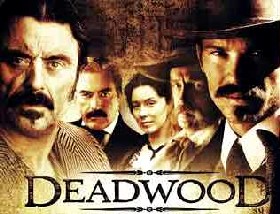
Deadwood - d'oh


As my holidays draw to a close, so too does my obsessive viewing of TV shows on DVD.  So far, I have knocked off all three series of BBC's Robin Hood, two series of The Big Bang Theory, two series of Friday Night Lights and now I have just finished watching the third and final series of Deadwood.

I had to Google the latter today after watching the final episode in the wee hours of the morning.  I thought perhaps I missed something as I felt somewhat dissatisfied at the way the show wrapped up.  I didn't expect an out-of-place montage tying up loose ends a-la Pushing Daisies, but I thought there would be some sense of closure for us viewers. 

However, it wasn't until this morning’s googling that I discovered two things.  Firstly, a fourth season was initially expected, which I decided could account for the anti-climactic ending….  But more importantly I was confronted with my own ignorance (at least in terms of American folklore), upon learning that the entire show was significantly based on fact!!!  D’oh!

 While watching I had been surprised at some of the liberties taken, through the introduction of 'Calamity' Jane and 'Wild' Bill Hickok, not realising until today that most of the other characters and many of the events of the show were actually also based on - as quoted by Wikipedia - 'historical truths' with a few embellishments added for the purposes of entertainment.

This knowledge would have informed my viewing and – more importantly - my expectations considerably had it been conferred on me previously.  Had I realised that there was some need to adhere to factual accounts; it would have lessened the aforementioned disappointment that the storyline didn’t reflect the kind of TV-land ending that allows viewers to sleep contentedly at night.   

A friend had tried to convince me to watch Deadwood for years but I had refrained, having little interest in the 'western' as a genre.  However, as it happened I discovered it in the same way I discovered some recent passions, Big Bang Theory and Entourage - through re-runs on television. 

Although I sped through the three seasons of the show and often refused to delay gratification, watching episode after episode, I didn't LOVE love it, ie. It isn't something I would watch again and again - my definition of a show I love.

There is no doubting, however, that the show was made by clever people and that is something I appreciate (hence my love of West Wing, Pushing Daisies, Buffy etc).  The scripts and dialogue were amazing and it wasn't until the second or third season that I became conscious that each line from a character's mouth was akin to Shakespearean prose (albeit slightly more colourful!), with the quality of the vernacular and use of soliloquies and monologues growing each episode.

I have to admit to being a bit gobsmacked while watching the first episode.  No one had warned me about the language.  Don't get me wrong, I swear like a trooper, dropping the F-bomb far too much and I must admit that the c-word doesn't even worry me much nowadays.... but I wasn't prepared for it on my free-to-air-TV viewing.  Wikipedia quotes that 'fuck' was used 43 times during the first hour of the show, setting the tone for the rest of the seasons, with the word used 1.56 times every minute of footage.  I expect the word 'cocksucker' featured as a pronoun almost as much.  Of course once inured to the language you realise that being called a (language alert!!!) loopy fuckin' c_nt is in fact a term of endearment.  At least in the characters' eyes. 


[caption id="" align="alignright" width="190" caption="Ian McShane & Timothy Olyphant (Swearengen & Bullock)"][/caption]

However, watching all three seasons in such quick succession allowed me to ponder a bit on my perceptions and my own reactions to them.  The first episodes introduce us to the two main characters, Seth Bullock (former Montana Sheriff and wannabe Hardware store owner in the lawless Deadwood) and Al Swearengen, owner of the local pub and whorehouse.  As I had seen half a dozen episodes on TV before borrowing the DVDs, I felt I already had a sense of the two protagonists: Bullock was a controlled and 'just' man with a sense of right and wrong; while Swearengen ruthlessly murders (by this own hand and others) for his own gain, treating all of those around him (liked and disliked) with disdain. 
So... it didn't really occur to me sometime until late in the second season that - in some respects - their roles (on the TV show at least) had reversed.  Swearengen had become the smarter 'player' weighing up the politics of the situations before him and demonstrating acts of kindness; and Bullock, faced with personal problems and complications was prone to 'flying off the handle' and acting irrationally.  Bullock was now the wildcard, his rage simmering just beneath the surface.   Those (like me) prone to online trawling for information would know there are entire Forums devoted to the ‘evolution’ of Swearengen throughout the show.

Of course, I realise that my early viewing was coloured by a lack of character development and the more dimensions to which we are privy, the more the characters change.  But it was a useful lesson to me.  I made my mind up too quickly.  I jumped in and judged who the baddies and goodies were without much thought.  And then I found it hard to change my allegiances.  Bullock was the hero for God’s sake!  As the seasons progressed, I found myself becoming more and more disappointed in him; as if he was letting me (personally) down through his increasingly-uncontrolled actions.

I gather (again, via Wikipedia) that the real-life Swearengen didn't demonstrate the same human touches as his screen character, and similarly, Bullock seems to have done well for himself in politics and in business - his real-life perhaps not fraught with the same complications as his Deadwood character. 

When Season 4 didn’t progress, creator David Milch was to have wrapped the show up via a series of TV movies, but four years later these have not eventuated.  A shame really, because while I can learn what happened to their real-life namesakes... I would kinda like to have known what would have happened to the Deadwood characters I'd known on-screen.

Wednesday, September 1, 2010

The X Factor

A few weeks ago, I was about to pull the plug on my anti-climactic Saturday night TV viewing when I came across a TV documentary about East Timorese leader, and current Prime Minister, Xanana Gusmão.


Xanana Gusmao 
I was in East Timor between 1999 and 2001 and met Xanana a few times.  I saw him speak, often in Tetum the local language, but although my comprehension was minimal I didn’t need to understand the words to know that he could certainly command a room. 


At that time, he had the respect and admiration of a whole generation of East Timorese.  His oratory skills and impassioned performances were amazing and he had the ability to quell angry masses frustrated with everything from the world’s inaction to the United Nation’s plodding progress in his country. 


He had something that many others do not.  Charisma. Presence… a certain something. 


It got me thinking about the X Factor.  That ‘something’ which separates Australian Prime Minister Bob Hawke, from John Howard or Kevin Rudd; and US President Bill Clinton from others who came before and after.


I remember when I was at school watching a young Sigrid Thornton in the TV mini-series All the Rivers Run and movie Man from Snowy River.  In the late 1970s and early 1980s she was Australia’s sweetheart, eventually departing for the US where she scored the lead in a (fairly-ordinary) TV western which ran for a couple of years.  I recall reading a quote about her in a magazine at that time in which someone described her allure, saying that the camera loved her; that it ‘ate her up’.  And it did.  We saw it years later when she again graced Australian small screens in the late 1990s in Sea Change.  She had a ‘certain something’ that she continues to bring to our screens, even today. 


I was reminded of this notion of charisma as I breezed through BBC’s Robin Hood recently. I have already confessed my lust for Richard Armitage’s Sir Guy of Gisbourne, but what surprised me was how engaging I found Robin himself.  Slim and (I suspect) not-universally-attractive, Jonas Armstrong brought something to the screen which surprised me.  In trying to describe him (in the role) to someone, I said he ‘twinkled’.  An unlikely candidate for the X Factor, Armstrong gave us a cheeky loveable larrikin who drew us in and before long (for me, anyway) he embodied Robin Hood. 


I’m not always as enamoured with TV characters and wonder if it is all about the X Factor.  I watch the TV show Castle for example, because I am a Nathan Fillion fan (from way back).  But I cannot - I repeat - I CANNOT, stand Stana Katic’s smug Kate Beckett.  She is certainly pretty and Hollywood-skinny so I find it hard to articulate why I haven’t ‘taken’ to her character, other than (perhaps) a certain coldness or lack of depth?  I suspect it is an issue of charisma.  And when a character is uninspiring, unsurprisingly I can’t engage with them or the show.  It is the reason that I used to love Law & Order – Criminal Intent, but never watched the original Law & Order; and perhaps the same reason I skip Law & Order – SVU if Mariska Hargitay isn’t featuring. 


Aussie actress Claudia Karvan
(Source: The Age)
It isn’t just about the quality of the acting, although it does help.  I will watch almost anything with Aussie TV actor, Claudia Karvan in it because she just brings ‘something’ to the screen every time.  Similarly I am enjoying our new television offering, Offspring, starring Asher Keddie who is remarkably engaging as the self-deprecating Nina. 


It’s why we want the good guys to win.  Or the bad guys to prosper.  It’s why we forgive Bill Clinton’s indiscretions or ignore Bob Hawke’s oafishness. It’s why certain actors or shows appeal to us and others don’t.  It’s how some people can command a room or a show, and others can’t… the X Factor which has nothing to do with singing and dancing.

Sunday, July 25, 2010

Bad boys, whatcha gonna do?

Let me start by prefacing this post with the statement that I do not, in real life, have a thing for ‘bad boys’.  As a natural cynic I have never aspired to find someone I can save, or change, or mould in any way.  This is because the man of my dreams will (of course) be a perfect specimen, not requiring any tweaking or shaping.  Hmmm… on further consideration this may well be why I am single! 

On screen however, it seems that my taste is far more seditious. 

I have just commenced a long holiday and after two laps of my local video store, I settled on the TV show Robin Hood (2006-2009).  I hadn’t ever watched it but recalled it being moderately popular and decided I was desperate enough to check it out for myself.  Given that there were only three Seasons made and all available, I also figured it would give me enough to do for a few days while not requiring me to wait (im)patiently for a new season to be released.

As I am not a fan of the ‘action’ genre, I expected that I might watch a few episodes before returning Season 1 mostly-unwatched.  However, to my surprise I literally inhaled two Seasons in less than three days and would have watched the final Season if some other pesky customer hadn’t kept it from me. 


[caption id="" align="alignright" width="300" caption="Richard Armitage as Sir Guy"][/caption]


Although Jonas Armstrong is surprisingly bewitching as Robin Hood, hero of the masses, it is the enigmatic and (frankly) bloody sexy Richard Armitage, who played Sir Guy of Gisborne who captured my heart.  Delivering on the Sheriff of Nottingham’s carnage does nothing to stymie my bad-boy adoration and (well, let’s face it)… lust.  Dark, brooding, sexy and sardonic, he is night to Robin’s day. He is my Mr Darcy, leaving Mr Bingham in his scathing wake.

It has made me wonder how much of the on-screen bad boy thing is expert casting rather than girl’s natural instinct to ‘turn-around’ a man who surely wants to be saved even though they may not actually know it.   In Robin Hood, Armstrong as its namesake is young and lanky and portrayed as a bit of a larrikin, whereas (be-still-my-beating-heart) Armitage is buff, stubbled and clad in black leather.  And in the first two Seasons (at least) we are privy to glimpses of humanity, leading us to believe he is not completely beyond redemption (and therefore worthy of our lust). 

Although it dates me, I recall similarly finding Luke Perry’s Dylan far more attractive than Jason Priestley’s Brandon on (the original) Beverly Hills 90210.  I preferred Chris Noth’s Big to John Corbett’s Aidan in Sex and the City.  And for a more timely pop culture reference I have to admit to a slight lustful interest in Glee’s Puck as opposed to, well…whatever the other guy’s name is… you know, the tall lanky blander-than-white-bread guy. 

Ever since James Dean graced the screens in the 1950s and studio bosses recognized our lust for the bad boy, casting directors have given us a choice.  Squeaky clean and cute, or sexy and broody. 

And in the parallel universe of film and television, I know which I am buying….

Friday, May 14, 2010

Far Eastern Odysseys and Emergency Sex

A few things have transpired in the last few weeks which have me thinking.  And pondering.

I have been quite unhappy at work for some time.  This isn’t necessarily a new thing as I get bored very easily and tend to change jobs with regularity.  At the moment however, although I contemplate alternatives, I find myself at a loss to identify what my options might be.  This had led me to reconsider a former career in aid and development - a previous life in which I worked and managed projects in developing countries.

Then, a couple of Tuesdays ago, I was channel surfing free-to-air TV and came across Rick Stein’s Far Eastern Odyssey.  It was the first show in the series and featured Cambodia.

I lived in Cambodia (aka Kampuchea; aka Cambodge) as a volunteer for about 7 months (until a coup d’etat) in 1997.  I returned for a month or so the following year as an election observer - part of a 20-person Australian / New Zealand contingent.

Generally I cannot watch shows or read about places I have lived or worked.  I’m not sure why.  Perhaps I feel the shows do not do the places and people justice, or that they objectify or patronise them.  Perhaps I have figuratively washed my hands of the places and people, moved on (literally) and don’t want to be reminded of them.  Or perhaps it is just the opposite and I find it painful to be reminded of previous lives and past regrets.  I don’t know.

But as it happened, I enjoyed watching Rick and his guides eating and cooking their way across Cambodia.  And, though over a decade since I was there, I felt a sense of familiarity and déjà vu.

Then….only a few days later I had a conversation with a fellow commuter, the way one does when they see the same strangers day after day.  Our smiles had become hellos and our hellos had become conversations.

This day – without knowing any of my history - she (for I still don’t know her name and keep meaning to ask!) told me how she would like to work in a developing country one day.  In the course of our conversation she talked about a book called, Emergency Sex and Other Desperate Measures: A True Story of Hell on Earth and offered to lend it to me.  And surprisingly she - my nameless fellow-commuter - appeared the following day with the book.

I, however, wasn’t sure I would want to read the book for the same reason I don’t watch stuff about places I have lived and worked.  So before receiving the book I was coming up with plausible platitudes which could fool her into thinking I had read the damned thing so as not to offend her generous gesture.

Surprisingly, although not particularly enamoured with two of the three authors (and protagonists), I demolished the book in two late-night reading sessions.

The book itself was written by three United Nations (UN) workers: Andrew, a NZ doctor, started out working for the Red Cross in Cambodia before the UN arrived en-masse to secure peace and democracy; Heidi, a disenfranchised recently divorced and broke social worker snared the UN gig to make some money; and Ken, a law graduate with an interest in human rights and no interest in actually practicing law.  The three cross paths in Cambodia in 1993 and continue to do so until the end of that decade and the book tracks them through the UN hotspots of Cambodia, Haiti, Somalia, Rwanda, Liberia and Bosnia.

I met some of these characters in my overseas exploits, particularly while living in Mozambique, Cambodia and East Timor.  Adrenaline junkies who move from emergency to emergency; UN Mission to UN Mission, many with little regard or thought for the people whose homeland they are inhabiting (albeit briefly).  Some good work is done but the motivations of many can be disheartening.

But even as I read this book and grimaced at some of the characters and happenings, I found myself feeling the familiar tinge of adrenaline and reminding myself of the good, rather than the bad.


[caption id="attachment_408" align="alignleft" width="300" caption="Me in Mozambique"][/caption]

Emergency Sex
returned to its commuter-owner, I am left pondering.  After my last overseas gig a decade ago: two years in East Timor then some time in the private sector involving a lot of travel in the Pacific, I yearned for normalcy.  I left the industry for what-I-hoped-would-be a more settled existence.  Indeed I have had absolutely no interest in traveling (anywhere or at all) since my return.  So why now am I surfing the internet for development jobs?  Am I like Heidi in Emergency Sex (who I quite disliked) - disenfranchised and looking for something new?  Or is my current lack of fulfillment because I have no sense that what I am (currently) doing makes a difference.  To anyone.

I tried to explain my lack of fulfillment to a boss a few years ago.  While living in developing countries the conditions are difficult.  You may not have access to regular electricity or running water.   Security may be an issue and you may be quite socially isolated.  So everyday life is hard.  A challenge.  As a result it doesn’t matter if work is maniacally busy or less-than-fulfilling because you don’t have the luxury of considering self-actualisation or pausing to ponder the meaning of life.  But in a world (here) where life is (mostly) easy, I find myself expecting more from my work.  More from people around me.  Often neither measure up. And this isn’t always their fault.

So, if I am honest, my desire to return to my previous life is as much about my dissatisfaction with the rest of my life as it is about work even though I realise my previous escapades did little to stave off the disenfranchisement.  So, I wonder why I think this time would be any different….